
Here’s what most practitioners miss: the true power of chiropractic is rooted in how well the nervous system can adapt to the world’s daily challenges. That’s why, over the past decade, I’ve become passionate about helping doctors like you measure—not guess—how resilient your patients truly are.
Enter Heart Rate Variability (HRV), and more specifically, the Rainbow Graph that appears in every neuroPULSE scan. With the right explanation and the right visuals, you can instantly shift a patient’s focus from short-term symptom relief to long-term neurological performance.
In this blog, we’ll walk through everything you need to know about HRV, how the Rainbow Graph works, and how to use these insights to upgrade your care planning, communication, and clinical certainty.
What is HRV and Why Does It Matter in Chiropractic?
Let’s start with the basics.
Heart Rate Variability (HRV) measures the tiny fluctuations in time between each heartbeat. It’s not just a rhythm or a simple pulse reading—HRV is a living indicator of how the autonomic nervous system (ANS) is working. This means it’s the most direct, non-invasive measure of your patient’s adaptability to stress and life’s daily demands.
How Does It Work?
Your heart doesn’t beat like a metronome. Instead, the timing between each beat varies ever so slightly, depending on the constant interplay between two nerve networks:
- Sympathetic Nerves (S): The “gas pedal” of your nervous system. Think fight-or-flight, adrenaline, and fast reactions.
- Parasympathetic Nerves (P): The “brake pedal.” These calm things down, encourage digestion, healing, and rest.
These two systems meet at the sino-atrial (SA) node of the heart, constantly balancing each other based on what life throws at you. HRV is the fingerprint of this balance.
Why Should Chiropractors Care?
Low HRV is linked to everything from accelerated aging and poor cardiovascular performance to increased risk of chronic illness. High HRV, on the other hand, means your patient is adaptable, resilient, and healing well. What’s more, mounting research shows that regular chiropractic care has a positive effect on HRV—helping patients not just feel better, but function better at the most fundamental level.
From Symptoms to Adaptability: The Paradigm Shift
For years, our profession has been pigeonholed as a “back pain” solution. But ask yourself—how many of your most challenging cases were really about vertebra, or even visible dysfunction, versus what’s happening behind the scenes in the nervous system?
That’s where HRV shines. Instead of just showing a static snapshot of muscle tension or posture, HRV gives you a real-time measure of how well your patient can adapt, recover, and thrive.
With the right tools and the right explanation, you’ll be able to say to your patient: “Here’s the story your nervous system is telling us. And here’s how chiropractic care can help you write a better one.”
Learn more about INSiGHT scanning?
Fill this out and we’ll get in touch!
"*" indicates required fields
The neuroPULSE: Bringing Research-Grade HRV Scanning to Your Practice
What is the neuroPULSE?
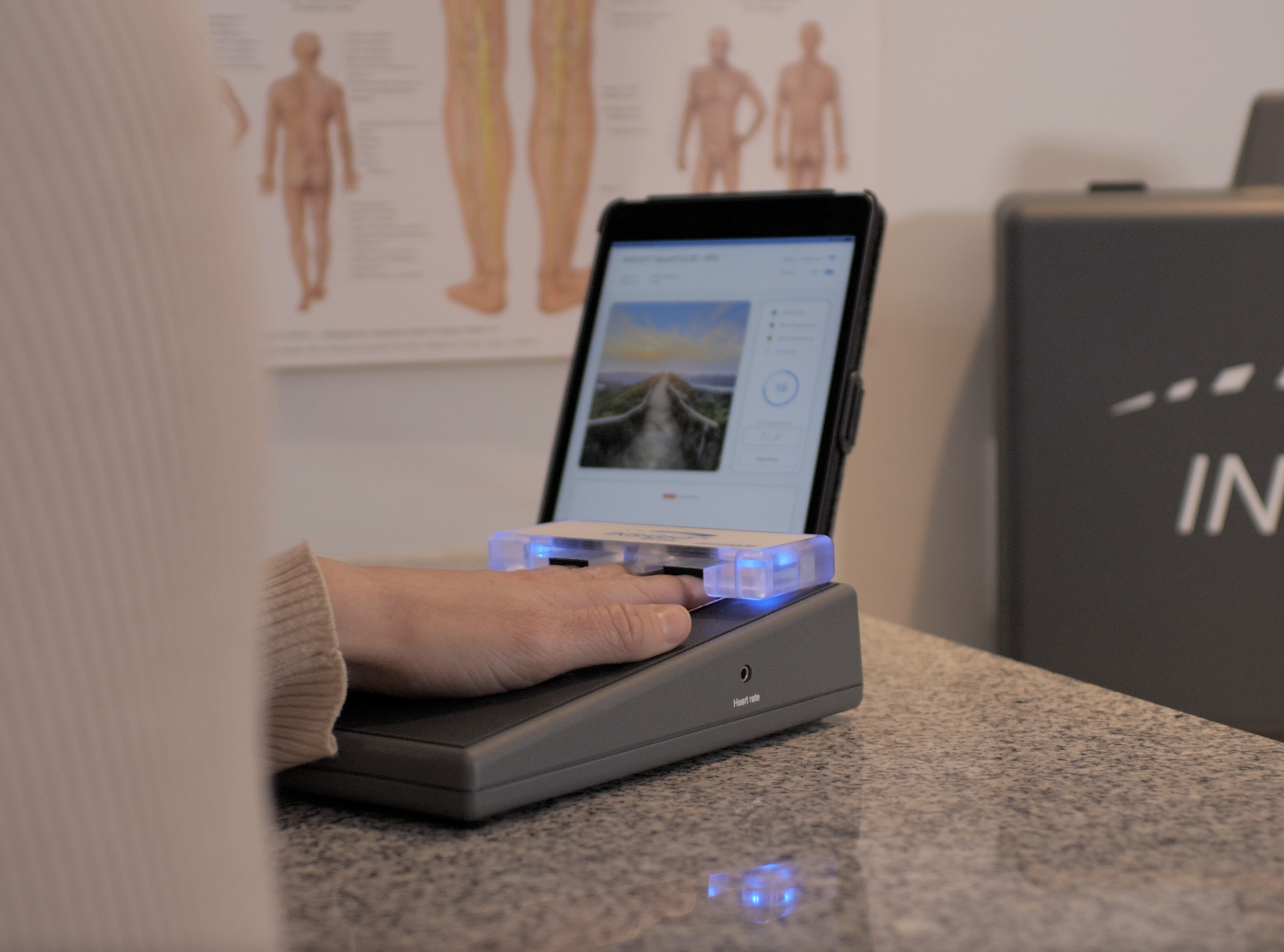
The neuroPULSE is INSiGHT CLA’s research-grade HRV instrument, designed for chiropractors. Using a simple three-minute, non-invasive scan, it analyzes the beat-to-beat variation in the patient’s heart rate, then plots that data on the Rainbow Graph.
Key Features
- Millisecond Precision: Measures heart rhythm with extreme accuracy.
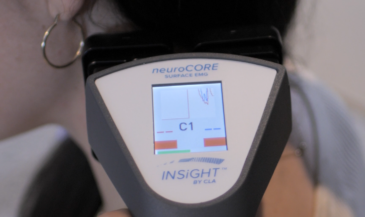
- Pediatric-Friendly: Ear clips and finger sleeves for newborns and children.
- Unattended Protocol: Three-minute collection, easily performed by trained staff.
- Objective Data: Generates clear, color-coded results for both the practitioner and the patient.
What Does It Actually Measure?
- Autonomic Balance Index (ABI): The ratio of sympathetic (fight-or-flight) to parasympathetic (rest-digest) frequencies.
- Autonomic Activity Index (AAI): The total adaptive reserve—the “horsepower” of the system.
Together, these numbers give you a clear view of how well a patient’s nervous system is keeping them balanced and ready for whatever comes next.
Introducing the Rainbow Graph: Making Complex Science Simple
The beauty of the neuroPULSE scan is how it translates complex HRV science into a visual format that anyone—practitioner or patient—can understand at a glance.
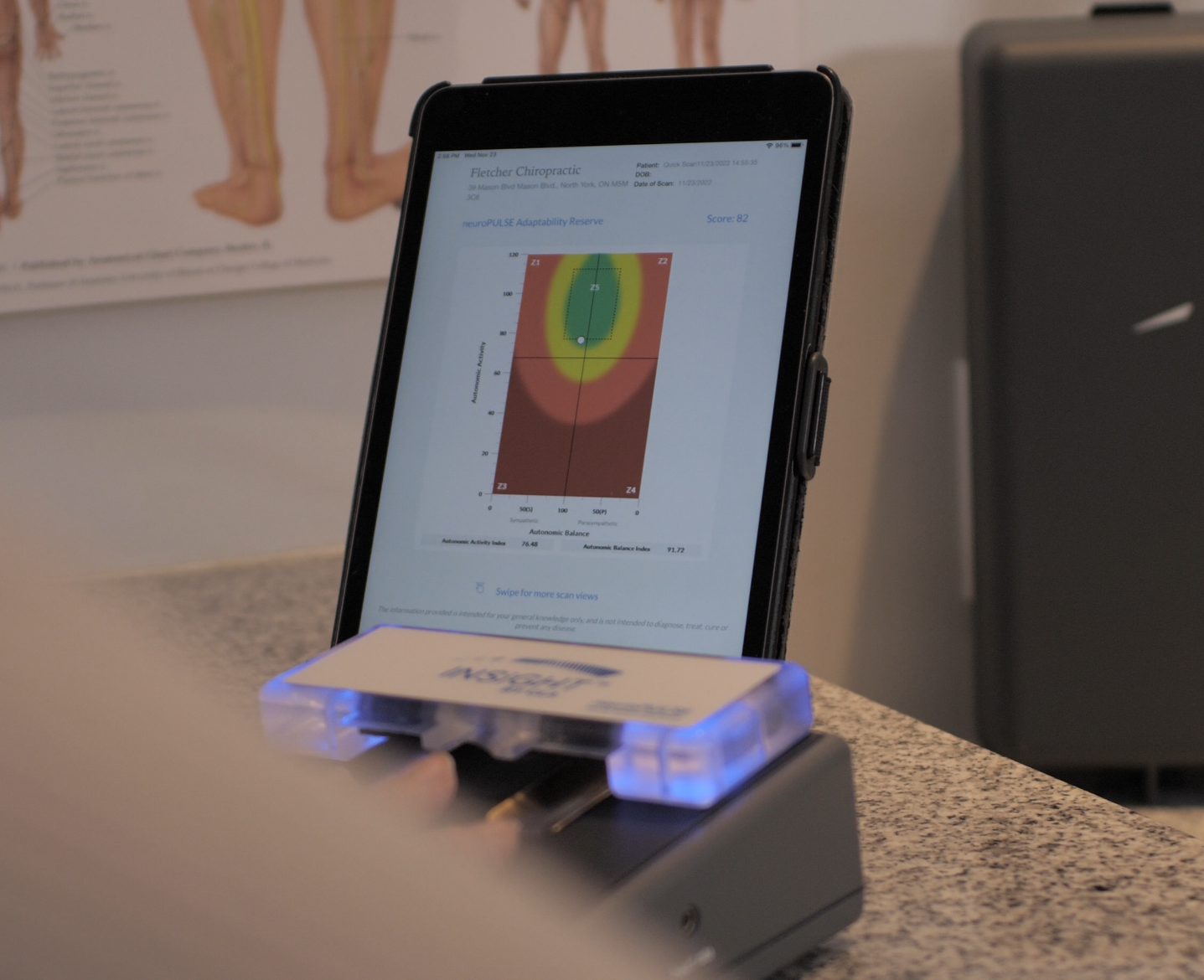
The Rainbow Graph is the heart and soul of neuroPULSE reporting. Here’s how it works:
Layout of the Rainbow Graph
- X-axis (Horizontal): Balance—left is sympathetic dominant, right is parasympathetic dominant.
- Y-axis (Vertical): Activity—higher up means more adaptive reserve, lower means less.
The combination of these two axes creates four primary quadrants (Zones 1–4) and a central “Green Zone” (Zone 5) that represents optimal adaptability.
What’s Plotted?
A white dot represents your patient’s current state. The closer that dot is to the center green zone, the more balanced and resilient their nervous system is.
The background of the graph is color-coded in a true “rainbow,” with green at the center (optimal), and yellow, orange, and red indicating rising levels of neurological distress.
Breaking Down the Five Zones: The Story Each Patient Needs to Hear
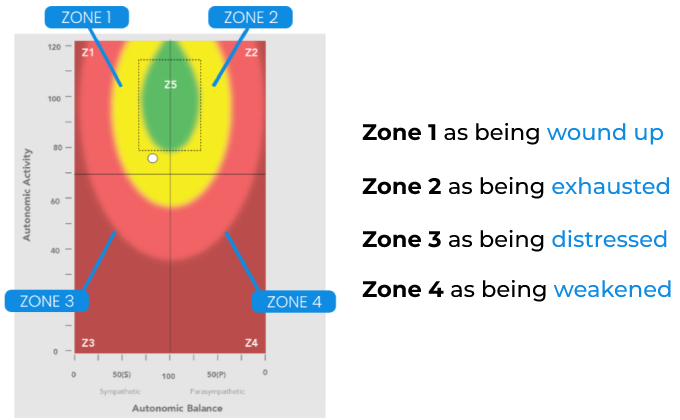
Let’s walk through what each zone on the Rainbow Graph means, and how you can explain this to your patients:
Zone 1: Uptight, High Reserve (Upper Left)
- State: Sympathetic dominant, high adaptive reserve.
- Typical Patient: Athletes, high performers, “CrossFitters.”
- Story: These patients are running hot—lots of energy, but also burning through reserves. Their body is adapted for stress, but not necessarily for recovery.
- Analogy: Like sitting at a stop sign, revving your engine. You look healthy, but you’re burning out your system.
- Care Focus: Reduce excessive sympathetic activity, restore parasympathetic control, emphasize recovery.
Zone 2: Exhausted, Sympathetic Insufficiency (Upper Right)
- State: Parasympathetic dominant, but only because sympathetic output is depleted.
- Typical Patient: Those with adrenal fatigue, chronic exhaustion.
- Story: This isn’t “good” dominance—these folks feel sluggish, unresponsive, and struggle to meet life’s demands.
- Analogy: Driving with the parking brake on.
- Care Focus: Restore vital responsiveness, rebalance the autonomics, gently build reserve.
Zone 3: Distressed, Low Reserve (Lower Left)
- State: Sympathetic dominant, low adaptive reserve.
- Typical Patient: Most new patients in a chiropractic office.
- Story: These individuals are stuck in stress mode but have little gas left in the tank. Immune function is lowered, inflammation is up, and recovery is poor.
- Analogy: Driving with an empty tank and failing brakes.
- Care Focus: Address sympathetic overdrive, build reserve, stabilize their baseline before pushing performance.
Zone 4: Weakened, Minimal Reserve (Lower Right)
- State: Low reserve, low parasympathetic responsiveness.
- Typical Patient: More often seen in medically managed settings—patients with severe chronic disease, extremely vulnerable to any stress.
- Story: The body is out of options, unable to mount a significant response to new challenges.
- Analogy: Brakes seized, the car barely moves.
- Care Focus: Often requires medical management. Chiropractic care should proceed cautiously, with strong collaboration and close monitoring.
Zone 5: The Green Zone – Balanced and Resilient (Center)
- State: Balanced autonomic function, high adaptive reserve.
- Typical Patient: Well-adjusted chiropractic patients; your “success stories.”
- Story: The nervous system is responsive, adaptable, and able to handle stressors with ease.
- Analogy: A high-performance vehicle running smoothly, ready for anything.
- Care Focus: Maintain and monitor, encourage continued lifestyle and care habits that support this state.
Reading the Rainbow Graph in Practice: The Science and the Art
The magic of the Rainbow Graph isn’t just in the data—it’s in how you use it with patients.
Show, Don’t Tell
When a patient sees their white dot on the graph—especially if it’s in the orange or red zone—they instantly “get” that something is off. You can say, “See this green zone? That’s where we want you to be. Right now, your nervous system is showing us you’re stuck in stress mode. Our job together is to move you towards that green.”
Connect the Dots to Care Planning
Use progress scans every 12 visits (the “Rule of 12”) to show movement toward the green zone. This transforms conversations from “How many visits will it take?” to “Let’s measure how your adaptability is improving.”
Table View and Data Interpretation
- AAI (Activity): Calculated from the amplitude within sympathetic and parasympathetic frequencies.
- ABI (Balance): Represents the ratio between S (low frequency) and PS (high frequency) activity.
- These scores are available in the Table View and can be used for more advanced tracking or research.
Beyond Pain: HRV and the Evidence for Chiropractic
There’s a growing body of research showing that HRV is a reliable and valid tool for measuring autonomic function, and that chiropractic adjustments can improve HRV and, by extension, adaptability and resilience.
Key studies include:
- Kent et al. (2017): Found that HRV is a valid measure for assessing changes in autonomic activity associated with the correction of vertebral subluxation.
- Haas et al. (2023): Showed that sustained chiropractic care is associated with improvements in HRV, suggesting long-term gains in resilience.
- McCraty & Childre (2010): Highlighted the concept of “coherence”—optimal balance between the heart, brain, and body—as a key to personal and even community health.
These studies support the vitalistic approach: Chiropractic care isn’t just about resolving symptoms. It’s about creating a resilient, adaptable nervous system so people can thrive.
Implementing HRV Scanning in Your Practice: Protocols and Pearls
Setting Up
- Integrate Scanning Into Every New Patient Exam: The Rainbow Graph should be part of your baseline assessment.
- Progress Scans: Repeat every 12 visits. This provides objective proof your care is making a difference.
- Pediatric and Special Populations: Use the finger sleeve or ear clip for newborns and young children. Children should naturally plot higher on the graph.
Patient Education
- Use Visual Language: “Let’s see where you are in the rainbow today.”
- Connect to Their Life: “Do you feel like you’re running on empty? Here’s the science behind that feeling.”
- Show Trends Over Time: Print and compare Rainbow Graphs to show progress.
Care Plan Development
- Zones 3 and 4: Start slow, focus on building reserve. Don’t push for performance until the nervous system is stable.
- Zones 1 and 2: Emphasize recovery and parasympathetic engagement.
- Zone 5: Celebrate, but continue monitoring. Even the most resilient patients can slip under stress.
Common Pitfalls
- Focusing Only on Symptoms: The Rainbow Graph helps shift the conversation to function and adaptability.
- Overcomplicating the Explanation: Use everyday analogies (car, gas pedal, brakes) to make the science relatable.
- Neglecting Progress Scans: Without follow-up data, you lose the opportunity to document and celebrate progress.
The Rainbow Graph as a Communication Tool: Elevating Patient Buy-In and Retention
One of the most powerful aspects of the Rainbow Graph is how it changes the patient-practitioner dynamic. No longer are you the “pain doctor”—you’re the performance and adaptability expert.
Visual Storytelling
- Yellow/Orange/Red: Use these as “stress categories.” Yellow is “Category 1 stress,” orange is “Category 2,” and red is “Category 3.” Most folks want to be in the green, not the red!
- White Dot Movement: Celebrate every shift towards the green, no matter how small.
- Progress as a Journey: “This isn’t a sprint; it’s about building lifelong adaptability.”
Talking Points for Table Talk
- “Your HRV is showing us how well your nervous system is able to adapt to stress—not just today, but in the long run.”
- “Most people come in running on empty. Our goal is to fill that tank and get you performing at your best.”
- “Even athletes can be stuck in the ‘uptight’ zone. Recovery is just as important as performance.”
Taking It Further: Research, Clinical Application, and the Future
The Rainbow Graph and neuroPULSE are more than just fancy technology—they’re the clinical future of chiropractic. As we move towards objective, vitalistic care, you’ll see:
- Increased referrals: Patients love being able to “see” their progress.
- Greater retention: Objective proof makes care plans compelling and understandable.
- Professional credibility: HRV research is respected in the broader health community, making it easier to build interdisciplinary bridges.
The Rainbow Graph—Your Bridge to the Next Level of Practice
When you put HRV at the center of your neurological assessments, you invite patients to see themselves not as broken, but as capable of growth, adaptation, and resilience. You move from “fixer of backs” to leader in wellness and performance.
So, the next time you sit down with a patient and pull up that Rainbow Graph, remember: you’re not just explaining a scan—you’re telling the story of what it means to thrive.
Let’s help every patient find their green zone. That’s something to get excited about.
Frequently Asked Questions: The Rainbow Graph and HRV Scanning
Q: What if a patient’s scan gets “worse” before it gets better?
A: Just like cleaning out a cluttered closet, sometimes things look messier before they reorganize. Encourage patients to look at trends, not just single points.
Q: Can HRV be influenced by outside factors?
A: Absolutely. Sleep, hydration, mental stress, even what they ate for breakfast can affect a reading. That’s why we recommend scanning under similar conditions each time.
Q: Is a high HRV always better?
A: Generally, yes—but context matters. For instance, abnormally high HRV in the context of illness can be a sign of loss of autonomic control.
Q: How soon should I expect to see changes?
A: Significant trends can be seen within 12 weeks of consistent care, especially when paired with lifestyle changes.