
HRV isn’t just a buzzword in biohacking or elite athletic circles anymore. In a chiropractic setting, it’s a performance metric for the autonomic nervous system (ANS)—a measure of balance, adaptability, and resilience. As we’ll explore in this article, HRV measurement helps us quantify how well the nervous system responds to stress, and how chiropractic care can create long-term improvements in neurophysiological health.
What Is HRV and Why Does It Matter?
At its simplest, HRV refers to the variation in time between heartbeats, and it’s controlled by the dynamic interplay between the sympathetic (fight or flight) and parasympathetic (rest and recover) nervous systems. A healthy heart isn’t perfectly rhythmic—it adapts from moment to moment, constantly adjusting based on internal and external demands.
That moment-to-moment flexibility is what HRV measures. A high HRV is associated with a greater ability to recover, respond, and regulate. A low HRV—often seen in patients under chronic stress—is associated with decreased adaptability and increased risk of cardiovascular, emotional, and immune dysfunctions.
Studies show that sustained chiropractic care can significantly improve HRV over time, reinforcing its value as a functional health marker.
The Role of HRV Measurement in Chiropractic
In chiropractic, we’ve always aimed to reduce interference in the nervous system—what we call vertebral subluxation. But what if you could track your progress beyond posture and pain? That’s where HRV measurement becomes indispensable.
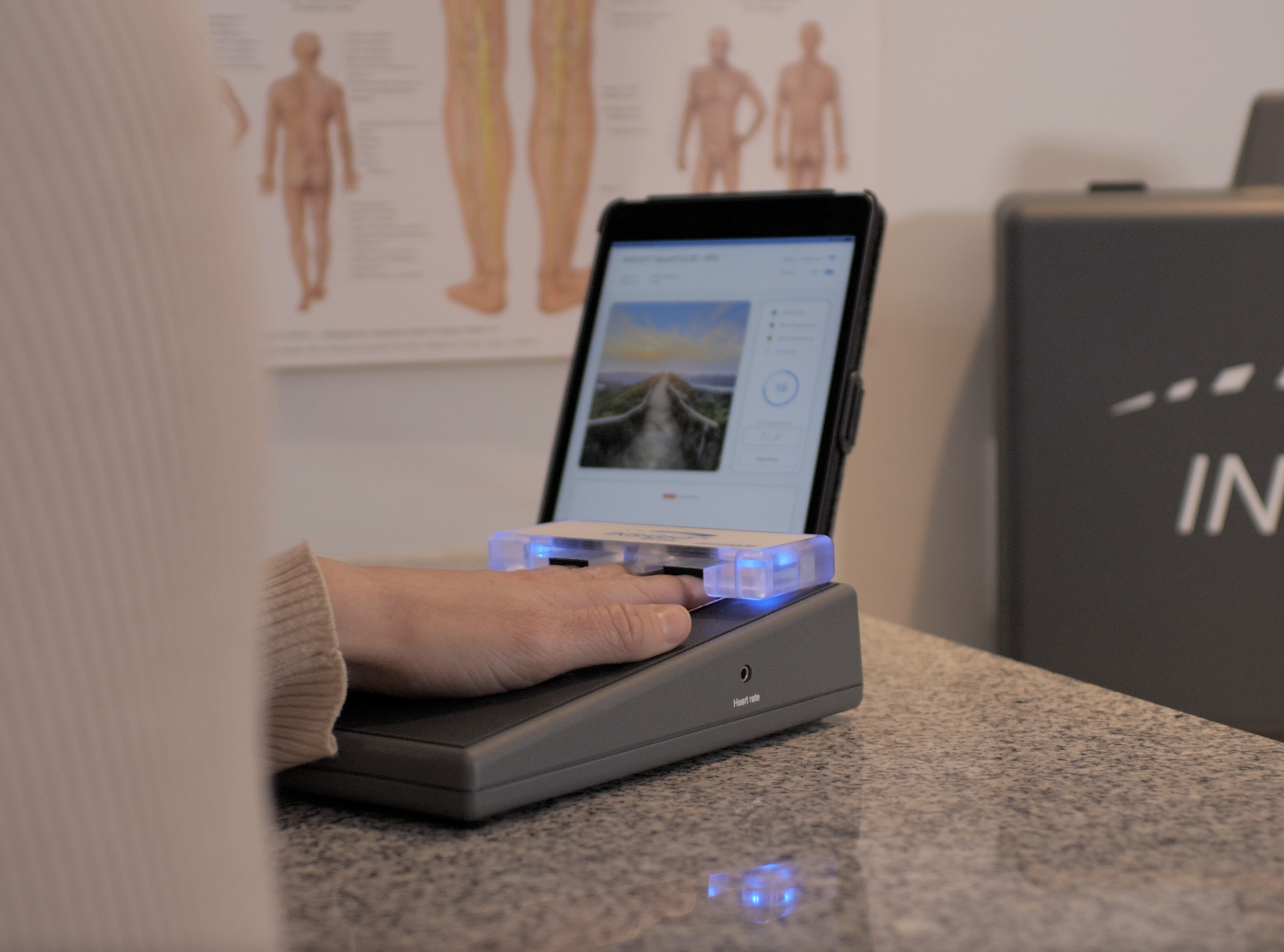
Using INSiGHT’s neuroPULSE system, chiropractors can:
- Objectively assess autonomic balance
- Monitor changes in adaptive reserve throughout care
- Establish measurable baselines and progress milestones
- Communicate care outcomes in ways that patients can understand
Research shows that chiropractic adjustments affect sympathetic and parasympathetic tone, validating the clinical impact HRV measurement can document.
Learn more about INSiGHT scanning?
Fill this out and we’ll get in touch!
"*" indicates required fields
HRV Metrics and Measurement Standards
There’s more to HRV than just the average beat-to-beat interval. True HRV assessment includes both time domain and frequency domain measures:
- SDNN (Standard Deviation of NN Intervals): Indicates total variability and resilience.
- RMSSD (Root Mean Square of Successive Differences): Reflects short-term vagal (parasympathetic) tone.
- LF (Low Frequency): Represents both sympathetic and parasympathetic influence.
- HF (High Frequency): Primarily vagal tone.
- LF/HF Ratio: Shows the balance or dominance of either nervous system branch.
The neuroPULSE, for example, distills these into two key indices: the Autonomic Balance Index (ABI) and the Autonomic Activity Index (AAI), allowing chiropractors to communicate findings with clarity and precision.
These assessments are validated against ECG standards. One clinical study analyzing chiropractic HRV outcomes demonstrated statistically significant increases in total power, SDNN, and both frequency bands after adjustments.
Introducing the HRV Rainbow Graph
Let’s talk visuals. One of the most effective tools in a neurologically-focused chiropractic practice is the Rainbow Graph, a proprietary display used in INSiGHT CLA’s scanning suite.
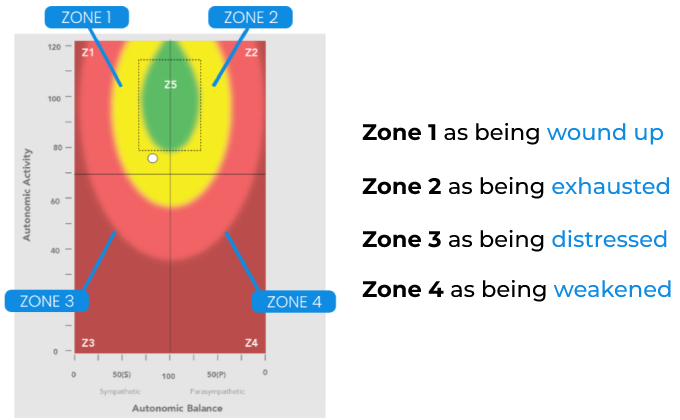
This XY graph plots:
- Autonomic Balance on the X-axis (sympathetic to parasympathetic)
- Autonomic Activity on the Y-axis (low to high reserve)
The graph divides into 5 zones:
- Zone 1 (Upper Left): Sympathetic dominant with high reserve—often athletes, yet stressed.
- Zone 2 (Upper Right): Parasympathetic dominant, but insufficient—often a sign of fatigue or burnout.
- Zone 3 (Lower Left): Sympathetic dominant with low reserve—common in new patients.
- Zone 4 (Lower Right): Severely weakened nervous system—low tone, low reserve.
- Zone 5 (Green Center): Ideal! Balanced and resilient.
With each scan, a white dot shows the patient’s current state—making invisible stress visible, trackable, and actionable. Read more about the Rainbow Graph model.
Measuring Change: HRV in Progress Exams
With HRV tracking, chiropractors can quantify progress, even in the absence of pain. This makes it a vital tool for communicating the true value of care beyond symptom relief.
Studies indicate that consistent HRV changes are observable within a 12-week window of consistent care. This timeline supports care planning focused on adaptive retraining rather than symptom chasing.
HRV Measurement and Patient Engagement
Patients feel better when they see results. HRV scanning creates moments of clarity during re-evaluations. They see that their body is less stuck in survival mode. They recognize that their nervous system is healing, not just their back pain fading.
In fact, the visual feedback loop that HRV provides boosts compliance and deepens trust. Patients begin to understand their health from the inside-out.
This isn’t about creating dependency—it’s about building autonomy. By visually tracking how care improves heart rate variability, they’re empowered to make choices for resilience, not just relief.
HRV as a Chiropractic Compass
Heart rate variability measurement has become more than a research tool—it’s a clinical compass for the modern chiropractor. It tells us where the patient’s nervous system is today, how well it’s adapting, and what’s changing over time.
From Zone 3 distress to Zone 5 coherence, HRV scanning makes progress real, visible, and measurable. In the hands of a neurologically-focused chiropractor, this technology does more than validate care. It transforms it.
If you’re still relying solely on symptoms or posture to guide your care plans, HRV is the missing link. It’s time to shift from pain to potential, from posture to performance, from structure to function.