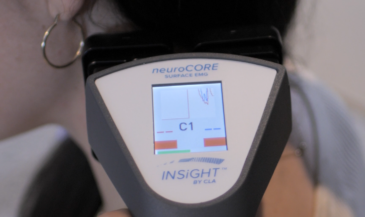


Heart rate variability (HRV) isn’t just about your heart—it’s about your nervous system. It tells us whether you’re stuck in fight-or-flight, or if your body has the flexibility to adapt, recover, and respond to life’s demands. In fact, HRV may be the most sensitive and accessible measure of your health and resilience.
But here’s the catch: there’s no single “normal” HRV value. Instead, the right question to ask is: how adaptable is your nervous system—and how can I track that over time?
Let’s explore why HRV is so much more than just data, how it reflects the story of your stress and recovery, and how chiropractic care brings that story into sharper focus.
What Is Heart Rate Variability and Why It Matters
Heart rate variability (HRV) is the measurement of the time gaps between each of your heartbeats. While your heart may beat at an average heart rate of 70 beats per minute, those beats don’t land perfectly on the second. One interval might be 0.86 seconds, the next 0.94—and that fluctuation is exactly what we want. HRV is the signal that your body is flexible and responsive.
To be clear, HRV is not the same as resting heart rate. Heart rate tells us how fast your heart is beating. HRV tells us how intelligently it’s responding to what’s going on around you. It’s a measure of your heart rhythm variability, not just beat count.
What makes HRV so powerful is its connection to the autonomic nervous system—the part of your brain and spinal cord that controls involuntary functions like breathing, digestion, immunity, and stress response. This system has two main branches:
- The sympathetic nervous system (fight-or-flight), which helps you respond to threats.
- The parasympathetic nervous system (rest-and-digest), which helps you recover, repair, and regenerate.
When your parasympathetic nervous system is engaged and working well—primarily via the vagus nerve—HRV goes up. When stress hijacks the system and you get stuck in sympathetic overdrive, HRV goes down.
HRV reflects nervous system and heart adaptability. It helps us see whether the body is shifting gears appropriately. When HRV is balanced and active, it’s a sign of strong neurological coordination—a healthy heart supported by a healthy brain-body connection.
What Should Heart Rate Variability Be? Understanding the Numbers
It’s the most common question people ask when they first see an HRV report: “What should my heart rate variability be?” And it’s a fair question—especially when you’re trying to make sense of numbers, trends, and zones on a heart rate variability chart.
Here’s the truth: There is no universal answer to what should heart rate variability be. HRV is like a fingerprint—unique to you. It’s shaped by factors like age, fitness, stress, and even your breathing rate. That’s why trying to compare your HRV score to someone else’s can feel like comparing apples to oranges.
Still, we can speak in general reference ranges. For RMSSD, a healthy adult might land between 30 and 100 ms. For SDNN, normal values range from 20 ms to over 200 ms.
Let’s look at some of the factors affecting HRV:
- HRV naturally decreases with age. A 25-year-old will typically have a higher HRV than a 65-year-old.
- Men often have slightly higher HRV than women, though this difference narrows with age.
- Fitness level: Athletes and physically active individuals tend to show better HRV.
- Time of day: HRV is generally higher during resting HRV periods and lower during activity.
- Chronic heart conditions can reduce HRV.
So, what should heart rate variability be? It should be a reflection of adaptability, not perfection. As long as your HRV over time is stable or improving, you’re on the right track toward good heart rate variability and overall health.
Learn more about INSiGHT scanning?
Fill this out and we’ll get in touch!
"*" indicates required fields
Factors Affecting Heart Rate Variability
Heart rate variability isn’t static. It’s one of the most dynamic metrics your body produces, responding in real time to life’s inputs. And because HRV is a highly sensitive signal, it picks up on the smallest disruptions in your internal environment.
- Sleep quality: Most HRV recovery happens during deep sleep.
- Spinal tension and vertebral subluxation affect your nervous system and HRV.
- Diet and hydration influence variability and vagal tone.
When these stressors accumulate, low heart rate variability can become the new normal. But it’s not permanent. Chiropractic care and lifestyle strategies can help improve HRV over time.
How Your Nervous System Influences HRV
Your nervous system is the master switchboard behind heart function. It determines whether your body speeds up, slows down, or shifts into healing. That’s why HRV reflects more than stress—it reflects function.
The autonomic nervous system consists of:
- The sympathetic system: accelerator mode.
- The parasympathetic system: brake mode.
Vagus nerve tone is essential to maintaining high heart rate variability. It keeps heart beats rhythmic and modulated.
When the system is dysregulated, HRV falls due to imbalance. Over time, this wears down resilience and increases dysfunction.
Using the HRV Rainbow Graph to Measure Adaptive Reserve
At INSiGHT CLA, the neuroPULSE scan and Rainbow Graph bring clarity to adaptability. Plotted on a color-coded chart, it visualizes your nervous system status using AAI and ABI scores.
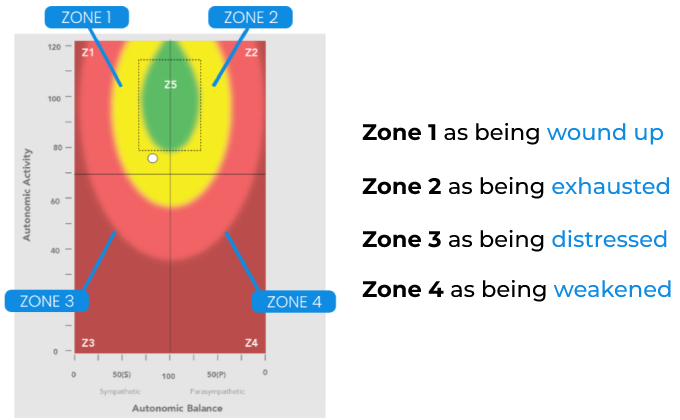
Here’s how the zones break down:
- Zone 1: High reserve, sympathetic dominant.
- Zone 2: Parasympathetic dominant, fatigued.
- Zone 3: Low reserve, sympathetic overload.
- Zone 4: Critically low reserve.
- Zone 5: The Green Zone—optimal adaptability.
This model helps chiropractors check heart rate variability and track patient progression toward a normal heart rate variability pattern.
High HRV vs Low HRV: What the Numbers Really Indicate
Consistently low HRV may reflect chronic stress, poor sleep, or neurological tension. But a single low reading isn’t a red flag—it’s the trend that matters.
In contrast, high HRV may signal parasympathetic dominance—and not always in a good way. In cases of adrenal fatigue, HRV appears high, but the system is underperforming.
Always interpret high or low HRV in context—and over time.
Improve Your Heart Rate Variability with Nervous System-Centered Care
Here’s how to improve your HRV and support your nervous system:
- Chiropractic adjustments restore neurological balance.
- Breathwork stimulates the vagus nerve and boosts HRV.
- Sleep, nutrition, posture, and hydration all support heart rate and blood pressure regulation.
- Athletes use HRV to plan their workouts and optimize recovery.
HRV Is the Language of Adaptability
So, what should heart rate variability be? It should be adaptive, responsive, and improving. HRV tells the story of your body’s flexibility—not just its performance.
Chiropractors use heart rate monitoring to measure adaptability, and chiropractic care to improve it. In a stressed-out world, HRV is how we make resilience visible.