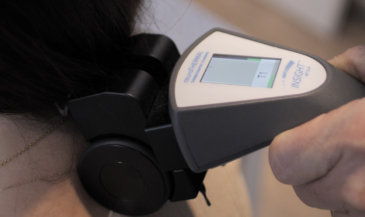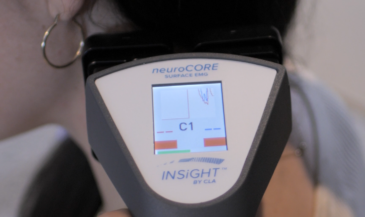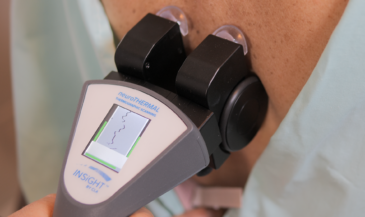


So, what is normal heart rate variability? That’s a great question, and the truth is: there’s no one-size-fits-all answer. A “normal” HRV is unique to you—shaped by your age and gender, fitness level, lifestyle habits, and even how you slept last night. Rather than chasing an exact number, the real value comes from knowing your baseline , at rest HRV and watching how it changes over time. That’s where chiropractic’s nerve-first approach, supported by HRV analysis, becomes such a powerful tool.
Understanding Heart Rate Variability (HRV)
At its simplest, heart rate variability is a measure of how much the time between your heart beats changes from one beat to the next. If your heart is beating 60 times per minute, that doesn’t mean it’s firing every exact second like a metronome. In fact, a resilient autonomic nervous system will cause small, healthy variations—one beat might come at 1.02 seconds after the last, the next at 0.98 seconds. These tiny changes, measured in milliseconds, are what we call HRV.
This variability tells us far more than the average heart rate ever could. It reflects how well your parasympathetic nervous system (the “rest and recovery” side) and your sympathetic nervous system (the “fight-or-flight” side) are working together. A good heart rate variability score means these two branches are in healthy balance, shifting seamlessly depending on your needs.
When you’re calm, your parasympathetic nervous system slows the heart, promoting recovery. When you face a challenge, your sympathetic nervous system raises your heart rate to respond. HRV is a highly sensitive indicator of how quickly and effectively you can make these shifts—and it’s routinely used to evaluate the autonomic nervous system in chiropractic and clinical contexts via heart rate variability to assess autonomic function.
Chiropractic care looks at HRV not just as a cardiovascular measure, but as a direct window into nervous system performance. That’s because your heart rhythm is under the influence of the brain and spinal cord every second of your life. A change in HRV may be the first clue that the nervous system is stuck in sympathetic overdrive or is lacking parasympathetic responsiveness—long before symptoms ever appear.
Why HRV Matters for Health and Performance
Your heart rate variability is more than just an interesting statistic—it’s a reflection of how adaptable you are to the demands of life. Think of it as your body’s “readiness score,” showing how prepared your nervous system and heart are to shift gears between effort and recovery.
A higher HRV is generally a sign that your body can respond well to challenges and bounce back quickly. Sports science relies on HRV to assess response to training and manage recovery. But you don’t have to be an athlete to benefit—anyone with a better HRV trend over time is building long-term resilience.
On the other hand, a low HRV can signal that your system is working harder than it should just to keep up. Low HRV is often associated with regulating inflammation via sympathetic pathways: prolonged inflammatory load and poor recovery can keep adaptability low. While a single low reading isn’t cause for panic, lower heart rate variability over weeks or months may be a clue that your system needs attention.
In chiropractic, HRV matters because it’s tied directly to the autonomic nervous system—the same system influenced by neurological interference along the spine. When the brain and body aren’t communicating efficiently, adaptability suffers, and that’s exactly what shows up in your HRV analysis. By improving nervous system balance and reducing interference, we aim to see changes reflected in HRV that point to better recovery and overall performance.
Learn more about INSiGHT scanning?
Fill this out and we’ll get in touch!
"*" indicates required fields
What Is a Normal Heart Rate Variability Range?
One of the first things people ask when they see their HRV score is, “Is that good?” The answer is—it depends. Normal heart rate variability doesn’t look the same for everyone, and comparing your number to someone else’s can be misleading.
For most healthy adults, short-term HRV values often fall somewhere between 19 and 75 milliseconds when measured under resting conditions. And calculated using SDNN methods. But these numbers are only part of the story. Normal HRV for adults is shaped by many factors:
- Age and gender – HRV naturally decreases as we get older, and younger people tend to have higher HRV. Women may have slightly higher values before menopause.
- Fitness level – Well-conditioned individuals, especially endurance athletes, often see higher heart rate variability—sometimes well over 100 milliseconds.
- Lifestyle and recovery – Sleep quality, nutrition, hydration, and daily stress loads all influence HRV.
- Overall health – Cardiometabolic risk states such as high blood pressure often accompany lower HRV and autonomic imbalance.
That’s why your normal HRV range is best determined by tracking your own baseline HRV over time. For example, if your average is 55 ms and suddenly drops to 35 ms for several days, that’s a sign worth paying attention to—even if 35 ms falls within a published “average” range.
In the chiropractic setting, we look less at whether your HRV fits a textbook definition and more at whether it’s improving under care. A trend toward better HRV is one of the clearest signs your autonomic nervous system is finding its balance and building resilience.
High HRV vs. Low HRV – What It Means
When it comes to heart rate variability, context is everything. A number by itself doesn’t tell the whole story—you have to consider your baseline, your HRV trends over time, and what’s happening in your life when you take the reading.
High HRV is generally a good sign. It suggests your parasympathetic nervous system is doing its job, keeping you adaptable and ready to recover. People with high heart rate variability can usually handle both physical and emotional challenges without staying in a stressed state for long. Athletes in peak condition, or individuals with consistent healthy routines, tend to have higher HRV.
Low HRV, on the other hand, can mean your system is stuck in sympathetic overdrive or lacking parasympathetic responsiveness. Low HRV can signal overtraining, lack of sleep, poor nutrition, ongoing illness, or unresolved neurological interference. In some cases, it shows up alongside cardiometabolic challenges like high blood pressure or insulin resistance.
Here’s the important part: a single lower heart rate variability reading isn’t an emergency—it might simply reflect a tough workout yesterday, a poor night’s sleep, or temporary illness. But when HRV decreases and stays down, it’s a clue that your nervous system and heart are working harder than they should just to keep up. That’s where regular monitoring becomes invaluable.
By combining HRV data with a full neurological evaluation, chiropractors can spot these patterns early. Over time, improvements in HRV become visible proof that your care plan is making a difference—not just in how you feel, but in how your body performs and adapts.
How to Measure Heart Rate Variability
You can only manage what you can measure—and with heart rate variability, accuracy matters. HRV is usually expressed in milliseconds, and those tiny differences between times your heart beats are easy to misread without the right tools.
There are several ways to measure heart rate variability:
- Electrocardiogram (ECG) – The gold standard in research, measuring the exact electrical signals of the heart. Used to detect pathologies.
- Mobile Photoplethysmography (PPG) – Common in consumer wearables like smartwatches and rings; uses light sensors to detect pulse waves.
- Clinical-grade HRV monitors – Designed for precise readings in a controlled environment.
While consumer devices are useful for tracking trends, they can vary in accuracy. A heart rate variability monitor used in a chiropractic setting is designed to remove those variables—controlling posture, movement and environment to ensure reproducible results. Within chiropractic, HRV is often paired with other objective assessments to evaluate autonomic patterns and direction of change.
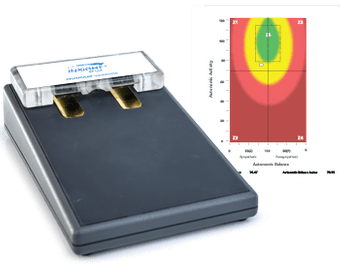
That’s where INSiGHT neuroPULSE comes in. This instrument collects HRV data in just three minutes, using millisecond-level precision and built-in quality controls. The results are instantly plotted on the Rainbow Graph, showing:
- Autonomic Balance Index (ABI) – Where you fall between sympathetic and parasympathetic influence.
- Autonomic Activity Index (AAI) – How much adaptive reserve your system has in the tank.
By pairing this analysis with the patient’s baseline HRV and ongoing HRV trends, chiropractors can clearly see how care is impacting adaptability. And when patients see these scan views in living color, the conversation shifts from “How many visits will I need?” to “How far can I take my resilience?”
Inside the neuroPULSE Technology
While there are many ways to collect HRV data, few tools are built specifically for the chiropractic setting. The INSiGHT neuroPULSE was designed with one goal: to make measuring heart rate variability accurate, repeatable, and meaningful for both the chiropractor and the patient.
Here’s what sets neuroPULSE apart:
- Millisecond precision – Captures each heartbeat interval with research-grade timing accuracy.
- Standardized 3-minute protocol – Ensures consistent comparisons over time.
- Immediate scan views – Results are instantly plotted on the Rainbow Graph.
- ABI & AAI metrics – Provide a complete picture of balance and activity.
- Integrated CORESCORE reporting – Combines HRV data with other neurological scans.
- Trend tracking for long-term care – Shows true progress over time.
With neuroPULSE, HRV stops being an abstract concept and becomes an everyday part of your clinical conversation. Instead of a patient leaving with just a number, they leave with a clear visual map of where they are, where they’re headed, and how your care is helping them get there.
Factors That Influence HRV
Your heart rate variability isn’t set in stone—it shifts constantly based on what’s happening in and around your body. While this is normal, knowing what can raise or lower HRV helps you understand the patterns you see in your HRV trends over time.
Lifestyle and recovery – Sleep quality, hydration, nutrition, and exercise load can improve or lower HRV; sport and rehab settings use HRV to assess response to training and manage recovery. Health status – Chronic inflammation and sympathetic dysregulation are linked through neuroimmune signaling, with the SNS playing a central role in regulating inflammation. Mental and emotional state – Ongoing stress can suppress parasympathetic responsiveness; vagal activation helps restore balance via the cholinergic anti-inflammatory pathway. Environmental factors – Climate, altitude, and early exposure to antibiotics and other environmental toxins play a role. Age and gender – HRV naturally decreases with age, and hormonal changes can affect averages.
Recognizing these influences is key to interpreting your baseline HRV correctly. This is why a single low or high reading is less important than the patterns you see over weeks and months.
Improving Heart Rate Variability
The good news about heart rate variability is that it’s not fixed. Whether your HRV score is high, low, or somewhere in between, there are practical, drug-free ways to help your nervous system become more adaptable.
Chiropractic adjustments remove neurological interference and restore balance, often resulting in HRV increases that reflect improved adaptability—documented in retrospective analyses of chiropractic care’s impact to improve HRV. Lifestyle support – Sleep consistency, balanced training, mindfulness, and quality nutrition all contribute to better HRV; slow, controlled breathing engages vagal mechanisms described in the cholinergic anti-inflammatory pathway. Trend monitoring – Regular scans with the neuroPULSE confirm when interventions are working and guide future decisions as part of chiropractic objective assessments.
Improving HRV is not about chasing a single “perfect” number—it’s about increasing your nervous system’s ability to adapt to whatever life throws at it.
HRV in Different Life Stages
Pediatric HRV – Naturally higher and valuable for tracking growth and development. Adult HRV – Stable with healthy habits, but vulnerable to lifestyle overload and sympathetic overdrive. Senior HRV – HRV naturally decreases with age, but even small gains can improve daily function and resilience.
At every stage, HRV is a sensitive marker of adaptability. The INSiGHT neuroPULSE helps chiropractors track these changes and keep patients’ resilience as high as possible.
Are You Using HRV In Your Practice?
Heart rate variability is more than a number—it’s a real-time reflection of how your nervous system is adapting to the world around you. Because normal heart rate variability is unique to each person, its true value comes from consistent tracking and understanding the story your numbers are telling. A healthy HRV doesn’t just indicate a strong heart; it shows a nervous system that can switch smoothly between effort and recovery, stress and restoration. That adaptability is the foundation for long-term health, vitality, and resilience.
In chiropractic, HRV bridges the gap between what we feel and how we function. With the INSiGHT neuroPULSE and Rainbow Graph, chiropractors can take a complex neurological process and make it visual, simple, and motivating for patients. As adaptability improves under care, the upward shift in HRV becomes undeniable proof that the body is regaining its balance. And when we can measure, understand, and improve that adaptability, we give patients more than relief—we give them the confidence that their nervous system is equipped for whatever life sends their way.