

Back stiffness is common, and sometimes the explanation is straightforward. An unfamiliar workout, lifting something heavy, prolonged inactivity, poor posture, or a minor strain can leave the back muscles guarded and restricted. Back stiffness may occur alongside back pain, or a patient may feel stiffness without much discomfort at all. There are also possible causes involving arthritis, a spinal disc, or other conditions that deserve appropriate evaluation.
But you and I both know the patient’s description is only the beginning. The interesting question is not simply, “How do we loosen this back?” The better question is, “Why is this patient’s body creating or maintaining this tension?” Once you ask that, back stiffness becomes more than a tight muscles conversation. It becomes a conversation about posture, protection, compensation, movement, and neurological control.
Common Causes of Back Stiffness and Why the Back Feels Tight
There is no single cause of back stiffness, and we should not force every patient into the same explanation. The common causes of back stiffness include muscular strain, overuse, prolonged inactivity, postural demands, reduced mobility, arthritis, and other spinal or structural issues. These are some of the same common causes of back pain, which is why a good history and examination matter.
The location can vary too. Some patients experience tension through the upper back. Others describe stiffness in your lower back, particularly when they first stand or begin moving. And while pain and stiffness frequently occur together, one does not necessarily require the other. “My back feels tight” is a description, not a diagnosis. The cause of your back stiffness may be quite different from another patient’s presentation even when both use exactly the same words.
Muscle Strain, Overuse, and Protective Guarding
One of the common causes of stiff back complaints is a strain or sprain. Lifting, bending, twisting, shoveling snow, returning to exercise, or asking the body to do more than it has been accustomed to can overload tissues and lead to stiffness.
The body may respond by protecting the region. Stiff muscles develop, movement becomes guarded, and the patient begins to feel restricted. That protective response makes sense. If the nervous system perceives that movement may cause pain or create further difficulty, restricting movement can be a reasonable short-term strategy.
But here is where I encourage chiropractors to think one layer deeper. Tight muscles are the output we observe. The nervous system is directing that output. That does not mean every strain is a neurological mystery. It means that when back stiffness persists or repeatedly returns, we should be interested in why the system continues asking those muscles to guard.
Sitting for Long Periods and Lack of Movement
You do not have to injure yourself to experience back stiffness. Sometimes you simply stop moving. Patients who spend long periods at a desk, in a car, or in one sustained position may notice stiffness when they finally stand. Gentle physical activity can often help ordinary mechanical stiffness loosen as the body starts moving again.
This is one reason avoiding back movement altogether is rarely a useful long-term strategy for uncomplicated mechanical stiffness. Appropriate movement helps maintain mobility, while regular physical activity can help prevent stiffness associated with prolonged inactivity.
But the chiropractor should still be curious. If relatively ordinary demands repeatedly cause back stiffness, what is the system doing during those hours of sitting? How efficiently is it organizing posture?
Posture, a Tight Hip, and Muscular Compensation
The region that feels stiff is not always the only region worth examining. A tight hip, limited hamstring mobility, reduced shoulder mobility, or poor coordination between the back and hip can contribute to back loading. When mobility is reduced above or below the lower spine, the lumbar region may compensate.
Reduced strength or coordination through the glutes, abdominal muscles, core muscles, and back muscles can also alter how load is managed. That is one reason exercises to strengthen core muscles are commonly included in conservative approaches for certain back complaints. A physical therapist may also use physical therapy, exercises and stretches to address mobility, strength, posture, and body mechanics.
For chiropractors, though, posture deserves more than a mechanical explanation. Posture is not simply where somebody puts their shoulders when told to stand straight. It is an ongoing neurological process. The nervous system continually receives sensory information and coordinates motor output to maintain the body against gravity. Even the curve of your lower back exists within that constantly adapting system.
Arthritis, Disc Changes, and Other Structural Causes
Not every stiff back is primarily muscular. Arthritis can contribute to inflammation, reduced joint mobility, stiffness and pain. Age-related changes involving a disc may also be associated with back pain and restricted movement. Other potential causes described in conventional back pain literature include spinal stenosis, scoliosis, spondylolisthesis, fractures, and inflammatory conditions.
These possibilities are why we should never declare the cause of lower back pain from stiffness alone. A patient saying, “My back is stiff,” does not tell us whether the situation is a temporary muscular response, structural concern, inflammatory process, or something else. History matters. Examination matters. Imaging matters when clinically indicated.
And then there is another question chiropractic is particularly well positioned to ask: What does the functional neurological picture look like?
Looking Beyond Back Pain to Understand a Stiff Back
Back stiffness is what the patient experiences. Postural tension is something we can investigate. That distinction matters because back stiffness and back pain are not interchangeable. Some patients have substantial tightness in your lower back with very little discomfort. Others experience lower back pain accompanied by guarding, spasms, restricted movement, or difficulty standing upright.
Another patient may report that their back pain has improved while compensatory patterns remain evident during the examination. Symptoms matter. They simply do not tell the whole story. If we only ask whether the patient can still feel stiffness today, we are relying on one moment in a much larger physiological story.
Tight Muscles May Be the Response, Not the Whole Problem
Muscles do not independently decide how much work they are going to do. Motor tone is neurologically controlled. The nervous system coordinates posture, movement, stabilization, and protective responses. When the body perceives increased demand or threat, muscular guarding can be part of that response and lead to stiffness.
That gives us a different way to think about the patient whose lower back always feels tight. Instead of stopping at, “Your muscles are tight,” ask a better question:
Why is the nervous system asking this region to work this hard?
That question changes the conversation. The goal is not simply to stretch your back until it temporarily feels looser. The goal is to understand why a spinal region may repeatedly return to guarding, compensation, or excessive postural tension.
Posture, Proprioception, and Compensation
The back and spine are part of a living sensory-motor system. Information about position, movement, load, and balance is continually being fed into the nervous system. Motor output is continually adjusted in response. When that process is efficient, the body can adapt to sitting, standing, walking, lifting, and changing positions without unnecessarily burning through energy.
When compensation enters the picture, certain regions may work harder. Limited hip mobility can contribute to back compensation. Another patient may brace excessively through the lumbar region. Someone else may develop a postural strategy that places different demands on the lower back.
The patient experiences the end result as stiffness. The chiropractor gets to ask what is organizing it.
Why Back Pain Alone Does Not Tell the Whole Story
Imagine asking only one question at every re-exam: “Does your back still feel stiff?” It is useful information, but hardly a complete assessment.
The answer can fluctuate based on yesterday’s workout, how long the patient drove, how they slept, or what they lifted. A subjective report captures experience. It does not necessarily reveal the underlying motor or neurological pattern.
That is why objective findings matter. History tells you what the patient has experienced. Your examination tells you what you find. Neurological scanning can add objective analysis of nervous system performance. Now the conversation is no longer limited to whether the patient feels looser.
Learn more about INSiGHT scanning?
Fill this out and we’ll get in touch!
"*" indicates required fields
Treating a Stiff Back Starts With Finding the Cause
When people search for treating a stiff back, they naturally want something they can do tonight. Back stretches. Heat. Ice. Exercise. Maybe over-the-counter pain relievers. These treatment options appear throughout conventional discussions of back pain relief, and some may be appropriate depending on the individual situation.
But there is no single effective treatment for every stiff back because there is no single cause. The first steps to take depend on the history, duration, severity, associated findings, and cause of your back complaint. The steps to take when treating an uncomplicated muscular strain will not necessarily be appropriate for stiffness associated with arthritis, significant trauma, or another condition.
Movement, Back Stretches, and Exercises to Strengthen the Core
For uncomplicated mechanical stiffness, staying appropriately active is commonly encouraged. Gentle walking, comfortable mobility work, and back stretches may help some people find relief. Prolonged bed rest is generally not the goal.
Strength matters too. Exercises to strengthen the core and surrounding musculature can improve the body’s ability to manage load. Improving hip mobility may reduce unnecessary compensation through the lower back. Depending on the cause of your back symptoms, a physical therapist may use physical therapy to address flexibility, mobility, strength, posture, and body mechanics.
These approaches may help alleviate back pain, prevent back stiffness associated with inactivity, and help prevent stiffness from recurring in some situations. But if a patient has been stretching the same region every morning for years because it always tightens again, the stretch may be addressing the sensation without answering the bigger question.
Why does the body keep returning there?
Heat, Ice, and Conventional Back Pain Relief
Heat is commonly used to relax stiff muscles, while ice may be used in some acute situations involving pain and inflammation. Over-the-counter pain relievers are another common approach people use to reduce pain and inflammation.
Those approaches belong in the larger back pain treatment conversation, but they primarily address symptoms. They do not automatically identify the cause of your pain or explain why recurrent back stiffness keeps returning.
Pain relief can be valuable. Feeling better is worth celebrating. But when evaluating recurrent or chronic back pain, symptom improvement should not automatically end our curiosity about function.
Where Chiropractic Adjustments Fit
Chiropractic adjustments are among the conservative hands-on approaches used for back pain and stiffness. But chiropractors sell ourselves short when we explain the adjustment as nothing more than a way to loosen a stiff joint or relieve pain.
Neurologically-Focused Chiropractic Care asks a bigger question. Where is neurological interference present? How is the patient adapting? What does the examination tell us about function? What findings are asking for attention?
The chiropractor combines the history, examination, neurological findings, and clinical judgment to create the care plan. The goal is not to promise that every adjustment will help alleviate back pain or that every cause back stiffness has a chiropractic answer. It is to understand the patient well enough to make a responsible recommendation.
When Back Stiffness Needs Additional Evaluation
Most chiropractors recognize when the story no longer sounds like routine stiffness. Significant trauma, progressive weakness, numbness, radiating signs, substantial loss of function, or other additional symptoms can require further assessment, imaging, medical evaluation, or referral.
Back and neck pain can have many causes, and appropriate differential assessment matters. The same is true when neck pain or low back pain appears alongside neurological findings or when a presentation is causing pain and stiffness that continues to worsen.
- History: When did the back stiffness begin, and what was happening around that time?
- Pattern: Is the stiffness constant, or does movement, sitting, sleep, or activity influence it?
- Associated findings: Are numbness, weakness, radiating signs, or other neurological findings present?
- Function: Does the patient have difficulty walking, standing, bending, or completing normal activities?
- Clinical context: Is there trauma, known arthritis, a disc concern, or another factor requiring further investigation?
Structural imaging and neurological scanning also need to stay in their proper lanes. An X-ray, MRI, or other imaging study may be appropriate when the clinical question involves structure or pathology. Imaging helps evaluate structure. Neurological scanning helps us analyze function.
How INSiGHT Scanning Helps Chiropractors See Beyond Back Stiffness
A patient can tell you, “My back feels stiff.” Your hands may find guarding. Your examination may reveal restricted movement. You may see altered posture or compensation. But what if you could also show the patient objective information about how their nervous system is organizing muscular and neurological responses?
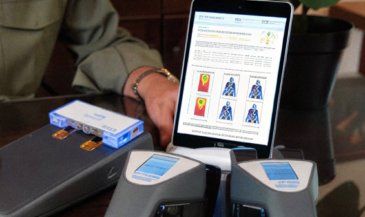
That is where INSiGHT scanning technology fits into the chiropractic examination. Its purpose is not to diagnose the cause of back stiffness, arthritis, a disc condition, or another pathology. INSiGHT provides objective neurological exam data and scan views that support the chiropractor’s interpretation.
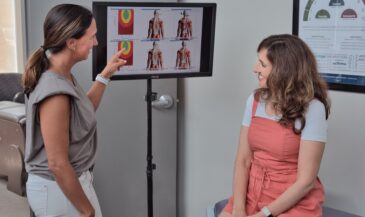
Neurological scanning shifts the patient’s attention from simply asking where their back hurts toward nerves and performance. Instead of having another conversation entirely about back pain, the chiropractor can begin showing the patient how their nervous system is performing.
neuroCORE Makes Postural Tension and Energy Use Visible
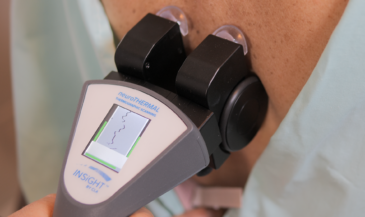
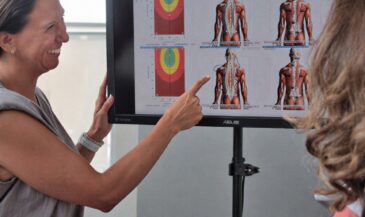
For the patient with recurring back stiffness, neuroCORE is particularly relevant. INSiGHT neuroCORE uses surface electromyography, or sEMG, to analyze electrical activity in the paraspinal musculature. That provides objective information about postural tension, symmetry, motor tone reactions, energy output, and compensation.
Think about how different that conversation becomes. The patient says, “My lower back always feels tight.” Instead of simply agreeing that they have tight muscles, you can examine what those muscles are actually doing.
Are particular spinal regions producing excessive activity? Is there asymmetry? Does the pattern indicate that the system is expending more energy than expected simply to maintain posture?
A patient may think the answer is another stretch. The more useful chiropractic conversation may be about how much energy their nervous system is spending to hold them upright.
neuroTHERMAL Adds an Autonomic View
The INSiGHT neuroTHERMAL adds another dimension by analyzing paraspinal temperature patterns associated with autonomic regulation. A full spine nerve system scan can be completed in under 30 seconds, making it practical for new patient examinations and progress assessments.
Rolling and segmental scan modes allow chiropractors to analyze neurological distress patterns and see how those patterns fluctuate. Thermal analysis does not diagnose the reason for a patient’s stiff back. It provides another functional view of autonomic patterns along the spinal regions.
A stiff back may be what the patient notices. The neurological picture can be broader than the place where they happen to feel stiffness.
neuroPULSE Looks at Adaptability and Reserve
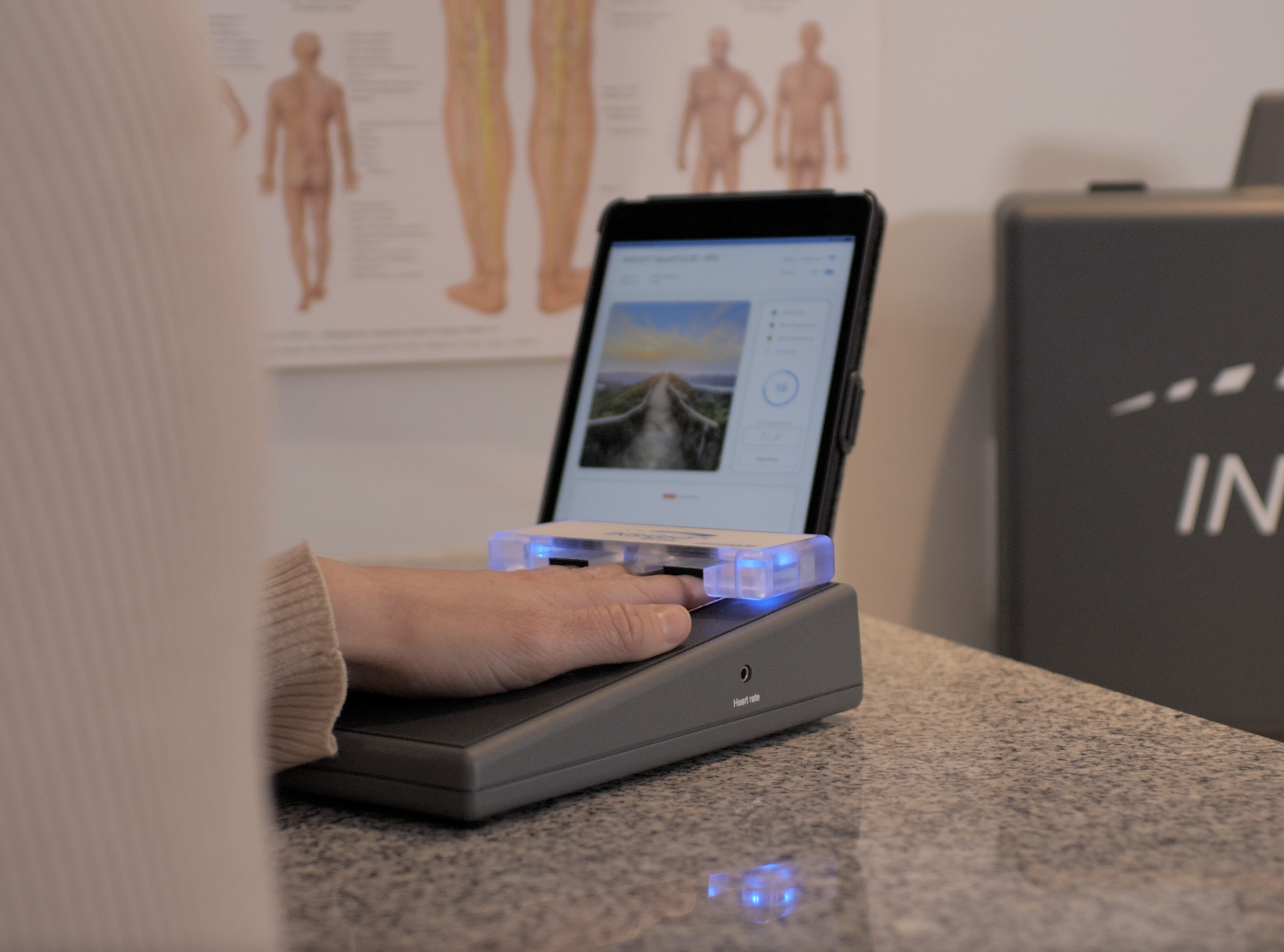
neuroPULSE analyzes Heart Rate Variability to provide information about autonomic balance, adaptability, recovery, and reserve. That matters because patients do not walk into your office as a collection of isolated body parts. The same nervous system coordinating posture and motor tone is continually responding to demand.
INSiGHT neuroTECH gives the chiropractor a three-dimensional neurological picture:
- Reserve with neuroPULSE: How much adaptive capacity does the system have?
- Energy with neuroCORE: How efficiently is the system organizing postural muscular activity?
- Depth with neuroTHERMAL: What autonomic patterns are showing up along the spinal regions?
Together, INSiGHT neuroTECH and Synapse software help chiropractors look beyond the one region that happens to feel stiff and toward the patient’s broader nervous system performance.
Baseline, Response, and Trajectory
This is where neurological scanning becomes particularly useful for patient communication. Start with a baseline. Assess response. Then follow the trajectory.
Without objective analysis, the progress conversation can easily become, “How’s the back?” “Pretty good.” “Still stiff?” “Sometimes.” That tells you something, but it does not tell you very much about nervous system performance.
With INSiGHT neuroTECH and Synapse software, chiropractors can compare scan views and discuss how nervous system status fluctuates over time. The technology provides objective information. The chiropractor combines those findings with history, examination, clinical judgment, and the patient’s goals to build the care plan.
When patients can see their nervous system in living color, the conversation stops being entirely about today’s back pain. They have a clearer way to understand performance, adaptability, and progress.
A Stiff Back Can Start a Bigger Chiropractic Conversation
“My back is stiff” is useful information. It is simply not enough information.
There are many reasons for a stiff back. Strain, inactivity, posture, tight hips, overuse, arthritis, spinal disc changes, and other structural or inflammatory situations can contribute to back stiffness. Appropriate movement, strengthening, lifestyle changes, physical therapy, chiropractic adjustments, or other options may have a role depending on the cause.
But the chiropractor has an opportunity to go further. When patients repeatedly experience back stiffness or low back pain, we can ask more than where they feel it. We can examine how they move, how they compensate, how posture is being organized, and whether their core and back muscles appear to be working harder than expected.
Most importantly, we can stop asking symptoms to tell us a story they were never capable of telling by themselves.
One patient may experience back stiffness before significant back pain appears. Another may feel better while functional patterns still deserve attention. Another may simply have a short-lived stiff back after doing too much over the weekend. Good chiropractic does not force all three people into the same explanation.
We examine. We analyze. We use objective information where it helps. And we make the recommendation that fits the person standing in front of us.
That is the bigger opportunity neurological scanning gives the chiropractic profession. Back stiffness may be the reason a patient starts the conversation. INSiGHT scanning technology gives chiropractors another way to assess the neurological story underneath it and track how nervous system performance fluctuates over time.
The stiff back gets their attention. The nervous system gives us the bigger story.